
Printed Electronics, Hydrogen Sensors and the Future of Organic Semiconductors

Image credit: Gerd Altmann from Pixabay.
Organic semiconductors may sound like an obscure corner of material science, but according to Prof. Thomas D. Anthopoulos, The University of Manchester, they could soon influence everything from the solar panels powering the IoT device ecosystem to the safety systems protecting future hydrogen-powered vehicles.
In a recent lecture titled “Organic Semiconductors for Renewable Energy and Hydrogen Safety Applications,” Anthopoulos outlined how these materials are opening the door to lightweight, printable electronics that are cheaper to manufacture and adaptable to entirely new uses. His work focuses on two major frontiers: printed solar cells and ultra-sensitive hydrogen sensors.
Yet despite the ambitious scope of the research, Anthopoulos speaks about it with striking humility. “I don’t think highly of my research, I just do what I enjoy,” he admitted during an interview following the lecture. But behind that modesty lies work that could make the transition to renewable energy technologies safer and widely accessible.
At the heart of his research is a deceptively simple idea: instead of relying solely on rigid silicon-based electronics, why not create electronic devices from organic materials that can be processed almost like ink? That approach enables flexible solar cells, printable electronics and nanoscale sensors that can potentially be manufactured at lower cost and used in entirely new ways.
“My work centres around electronic materials, primarily organic and metal oxides, and their use in real-world applications. This is the driving force for my research”, Anthopoulos explains.
Flexible solar cells and the future of renewable energy
One exciting area discussed in the lecture was organic photovoltaics – solar cells made using soft organic semiconductor materials. Unlike conventional silicon solar panels, these devices can be made ultra-thin, lightweight and flexible enough to be printed onto surfaces of arbitrary size and form.
Anthopoulos described strategies to push the efficiency of these solar cells beyond 20%, bringing them closer to the performance of incumbent silicon photovoltaics (~25%). He discussed the development of improved charge-extracting interlayers, antireflection coatings and molecular dopants that boost both efficiency and operational lifetime.
The appeal is easy to grasp. Imagine solar technology integrated into windows, portable devices, clothing or curved surfaces where traditional rigid panels simply cannot work.
But the work goes far beyond making electronics flexible. Anthopoulos and his team are also developing ways to manufacture devices at the nanoscale without relying on expensive fabrication facilities.
“We try to democratize nanotechnology,” he said.
That phrase captures much of the philosophy behind his research ethos. Traditional nanotechnology often depends on highly specialised and costly equipment. Anthopoulos’ group instead investigates molecular self-assembled monolayers that can naturally organise themselves into one-molecule-thin structures without relying on costly manufacturing tools and processes.
These self-assembled monolayers featured prominently in the lecture. In photovoltaics, they can serve as active components that improve device performance while minimising material use: 1 gram of a typical self-assembled monolayer can cover several 100s of square meters of solar panels. Elsewhere, they can aid the formation of nanostructures without the need for complex lithography techniques used in conventional semiconductor fabrication plants.
The result is a potential pathway toward advanced electronics that are cheaper and more sustainable to produce at scale.
Hydrogen sensors could become essential safety technology
While flexible solar cells may sound futuristic, Anthopoulos believes one of the most immediate impacts of his work could come from a very different application: hydrogen sensing.
Hydrogen is increasingly viewed as a key player in the transition to cleaner energy systems. It can be used as an energy carrier to power vehicles or energy-intense industrial processes without producing carbon emissions at the point of use. But hydrogen also presents a major challenge: it is colourless, odourless and highly explosive.
Detecting leaks quickly and accurately is essential if hydrogen infrastructure is to become widespread.
That is where organic-semiconductor-based hydrogen sensors enter the picture.
In his lecture, Anthopoulos described sensors capable of extremely fast (less than a second), selective, and sensitive hydrogen detection. The performance of this technology surprised even his own research team.
“We’re really, really surprised to find that our technology could potentially outperform the majority of sensors currently in the market,” he said.
If successful, such sensors could eventually be integrated into homes, vehicles, industrial facilities and transport networks that use hydrogen fuel systems.
“Hydrogen will be everywhere, and technologies that accelerate its adoption by improving confidence will emerge as key enablers,” Anthopoulos predicted.
The power of a “beginner’s mind” in science
Anthopoulos’ path into science was far from straightforward. Now a leading figure in his field, with previous appointments at Imperial College London and King Abdullah University of Science and Technology before joining The University of Manchester, he openly admits he was not always an ordinary student.
“I was not an archetypal student,” he said. “Since I can remember, I have been intrigued by experiments and the thrill of discovering new things.”
In his academic life, everything changed when he was introduced to organic semiconductors during his PhD work. The field appealed precisely because it blended multiple disciplines together.
“It combines chemistry, material science, electronics, physics, devices – everything comes together to suddenly produce technologies with unrivalled characteristics.”
That unconventional background soon became his greatest strength. Not following the standard route into the field, he often approached problems differently from specialists who had spent years thinking within established frameworks.
Anthopoulos refers to this perspective as maintaining a “beginner’s mind.”
“You have no biasing towards specific processes and observations. Your mind is a Tabula Rasa (Latin for ‘blank slate’),” he explained. “It just comes as like, ‘Oh, could this be possible?’”
That openness and curiosity, he believes, enabled observations and discoveries that others may have overlooked. Even now, decades later, he says he continues to build on ideas that first emerged from that fresh perspective.
Turning laboratory research into real-world technology
Despite the promise of the technology, Anthopoulos emphasised that translating laboratory discoveries into commercial products remains the hardest challenge.
“We can do great research, publish big papers,” he said. “But translating these findings into a useful commercial product… that’s tough.”
For a scientist whose work spans renewable energy, nanotechnology and hydrogen safety, the next step is no longer just discovery. It is learning how to bridge the gap between academic innovation and industrial adoption.
“This is my personal position right now,” he said. “Finding ways to translate our best research into valuable, useful technological products for our society and our planet.”
If organic semiconductors ultimately help create safer hydrogen infrastructure or more sustainable renewable energy technologies, that translation may prove just as important as the original discoveries themselves.
About the interviewee
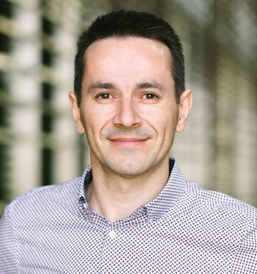
Thomas D. Anthopoulos is a Professor of Emerging Optoelectronics and the department head of research at the Department of Electrical and Electronic Engineering at the University of Manchester. Following the award of his BEng and PhD degrees, he spent two years at the University of St Andrews (UK), where he worked on organic semiconductors for light-emitting diode applications before joining Philips Research Laboratories (The Netherlands) to focus on printable microelectronics. From 2006 to 2017, he held faculty positions at Imperial College London (UK), first as an EPSRC Advanced Fellow and later as a Reader and full Professor of Experimental Physics. From 2017 to 2023, he was a Professor of Material Science at King Abdullah University of Science and Technology (KAUST) in Saudi Arabia.
By Dr Karen Steward