

Image credit: Gerd Altmann, Pixabay.
By Dr. Karen Steward
Materials that can move, change shape, heal themselves and adapt to their surroundings may sound like science fiction, but they are rapidly becoming a reality. That was the message delivered today by Prof. Eugene Terentjev, of the University of Cambridge, as he explored how advances in soft-matter physics are opening the door to a new generation of responsive and sustainable materials.
Speaking as part of the QAMSS lecture series, Prof. Terentjev presented his talk, From Molecular Order to Mechanical Function: Liquid Crystal Elastomers and Sustainable Adaptive Materials, charting the development of a field that combines the physics of liquid crystals with the elasticity of rubber to create materials capable of remarkable mechanical behaviour.
The lecture challenged the common perception of soft materials as passive or weak. Instead, Prof. Terentjev highlighted how molecular order, elasticity and internal motion can work together to produce adaptive mechanical functions, enabling materials to respond dynamically to changes in their environment.
From physics to smart materials
At the heart of the talk were liquid crystal elastomers, a class of materials that can change their shape and properties when exposed to external stimuli. Explaining their unique capabilities, Prof. Terentjev said: “Liquid crystal elastomers combine the elasticity of rubber with the molecular order of liquid crystals. This means that their shape and mechanical properties are not fixed: they can change in response to heat, light, stress or chemical environment.”
He added that “because molecular orientation is directly coupled to deformation, these materials can act as actuators, dampers, reversible adhesives or shape-changing structures.”
According to Prof. Terentjev, the significance of these materials lies in their versatility. “Their promise lies in this rare combination of softness, internal order, large reversible deformation and programmable mechanical response,” he said.
The lecture also explored how fundamental soft-matter physics can contribute to some of today's most pressing technological challenges, including sustainability, recyclable polymers, soft robotics and mechanically functional materials. By understanding how molecular structures influence behaviour at larger scales, researchers are developing systems that can be reprocessed, recycled and adapted for a wide range of applications.
Learning from living systems
In an interview about his work, we asked Prof. Terentjev how close researchers are to creating materials that behave like living systems. While cautioning against overestimating current capabilities, he pointed to significant progress.
“We are still far from the full complexity of living matter, which senses, processes information, repairs itself and adapts through highly organised biochemical networks,” he said. “But we are beginning to build materials that show selected life-like behaviours: movement, responsiveness, memory, self-healing, reversible adhesion and adaptive stiffness.”
He argued that the goal should not simply be to copy nature. “The important step is not to imitate biology superficially, but to learn from it: to design materials whose function emerges from internal structure and feedback, rather than from external control alone.”
The lecture offered a compelling glimpse into a future where materials are no longer passive components but active systems, capable of responding, adapting and performing functions that increasingly blur the boundary between engineered matter and the living world.
About the interviewee
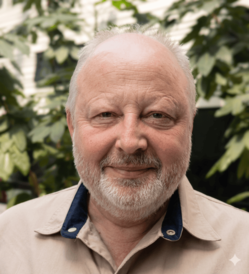
Prof. Eugene Terentjev, University of Cambridge
Eugene Terentjev is the Professor of Polymer Physics at the Cavendish Laboratory, University of Cambridge, and a Fellow of Queens’ College. Educated in Moscow, where he trained in physics and crystallography, he moved to Cambridge after earlier research posts in Moscow and the USA. His work spans soft condensed matter, polymer physics, liquid crystals, colloids and biological physics. With Mark Warner and others, he helped establish the modern physics of liquid crystal elastomers, a field connecting molecular order, elasticity and mechanical function.