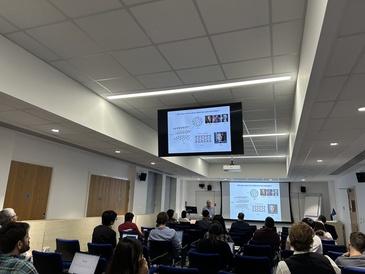

QAMSS was honoured to welcome Professor Reshef Tenne from the Weizmann Institute of Science, for the final QAMSS SRI Advanced Technology Lecture of this term, held this afternoon at the Cambridge Graphene Centre (CGC).
Prof. Tenne, a pioneer in the field of inorganic nanotubes, delivered a captivating talk titled:
"Inorganic Nanotubes: From WS₂ to 'Misfit' Compounds"
Drawing from decades of groundbreaking research, Prof. Tenne provided a comprehensive update on the synthesis and characterization of new inorganic nanotubes (NTs) derived from 2D compounds such as W(S,Se)₂ and complex core–shell NTs. His talk highlighted the quantum mechanical phenomena observed in these nanostructures, including:
Strong coupling between optical cavity modes and excitonic transitions
Little-Parks oscillations in 1D superconducting NTs
The bulk photovoltaic effect unique to curved 1D nanotubes
An innovative "artificial recording eye" using a 4×4 WS₂ NT array, combining vision, storage, and writing capabilities
Prof. Tenne also discussed the development of nanotubes from quaternary “misfit” layered compounds (MLCs), emphasizing recent advances in tailoring rare-earth (RE) and transition metal interactions to produce highly anisotropic structures. Remarkably, these NTs exhibit large local dipole moments and are being explored for their potential in quantum technologies, including 1D superconductivity.
His insights, rooted in both theoretical understanding and advanced synchrotron-based experimental techniques, sparked vibrant discussions among attendees from across the University.
QAMSS would like to express sincere thanks to Prof. Tenne for his visit and for sharing his cutting-edge research with our community. We also extend our appreciation to all who attended this enriching session.
Stay tuned for more QAMSS events in the new academic term, as we continue to spotlight global innovation in quantum and advanced materials.