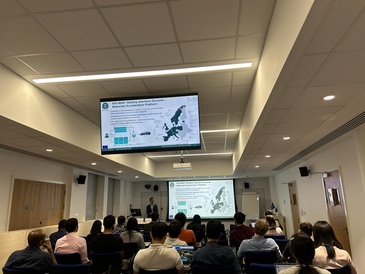
On 27 June 2025, QAMSS was pleased to welcome Professor Tejs Vegge from the Technical University of Denmark (DTU) to deliver a lecture at the Cambridge Graphene Centre (CGC) as part of the ongoing QAMSS Easter Term lecture series.
Professor Vegge, who leads the CAPeX Pioneer Center for Accelerating P2X Materials Discovery, presented his recent work on integrating machine learning and autonomous laboratory frameworks to accelerate the discovery of sustainable battery materials and electrocatalysts.
His talk, entitled "Accelerated Materials Discovery Using Machine Learning and Federated Self-Driving Labs – A Case Study for Batteries and Electrocatalysts", introduced the FINALES (Fast INtention-Agnostic LEarning Server)framework. This system enables geographically distributed laboratories to conduct joint, closed-loop optimisation tasks. As an example, he described a dual-branch optimisation of battery electrolytes—specifically, varying compositions of ethylene carbonate (EC), ethyl methyl carbonate (EMC), and lithium hexafluorophosphate (LiPF₆)—with the goal of improving both ionic conductivity and cell lifetime.
The second part of the lecture addressed spatio-temporal structure–property relations at solid–liquid interfaces. These are critical to understanding phenomena such as Solid Electrolyte Interphase (SEI) formation, which limit battery performance. Professor Vegge discussed how ab initio molecular dynamics (AIMD) simulations, while accurate, are often computationally prohibitive for the time and length scales involved. He presented recent progress on developing machine learning-based interatomic potentials and transition state datasets capable of capturing activated processes and interfacial chemical reactions.
The lecture concluded with a discussion on materials representation in machine learning, highlighting recent findings where even chemically intuitive, structure-free representations (such as chemical formulas) have yielded unexpectedly strong predictive performance. This raised important questions about the nature of material descriptors and their relationship to target properties, which his group is addressing through a new tomographic and information-theoretic framework.
We thank Professor Vegge for visiting Cambridge and for contributing to the QAMSS lecture series with a stimulating and timely presentation. His lecture prompted thoughtful discussion among attendees and underscored the importance of interdisciplinary approaches to data-driven materials science.