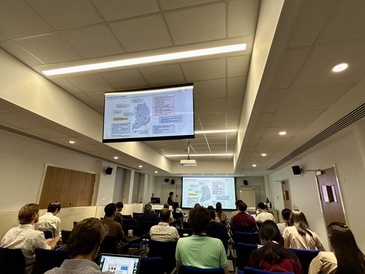
On 25th July 2025, the Quantum and Advanced Materials for a Sustainable Society (QAMSS) Strategic Research Initiative at the University of Cambridge had the honor of welcoming Prof. Hyeon Suk Shin from the Institute for Basic Science (IBS) and Sungkyunkwan University, Republic of Korea. Prof. Shin delivered a fascinating lecture on the Growth and Functionalization of Single-Crystal Hexagonal Boron Nitride, which was the final lecture of this term's QAMSS seminar series.
Hexagonal boron nitride (hBN) has emerged as a highly attractive material in materials science due to its remarkable properties. With its unique optical characteristics in the deep-UV region, exceptional mechanical strength, thermal stability, and chemical inertness, hBN holds great promise for a variety of applications. These range from nanoelectronics and photonics to single-photon emission (SPE), anti-corrosion coatings, and even membranes. However, for industrial-scale adoption of hBN, the wafer-scale growth of high-quality thin films is essential. Prof. Shin’s lecture focused on the state-of-the-art strategies used to achieve this.
During his talk, Prof. Shin shared insights into the complex mechanisms behind the growth of hBN films on catalytic substrates, such as Nickel (Ni) and Copper (Cu). He discussed how these films are grown at a wafer-scale level and the factors influencing their quality and performance. Prof. Shin also explored the innovative functionalization of hBN layers, particularly its influence on SPE, which is crucial for advancing the material’s use in quantum technologies and other high-tech applications.
A key highlight of the lecture was the demonstration of how cyclodehydrogenation of hexaphenylbenzene and oxidative polymerization of dopamine can be achieved without catalysts by utilizing the unique high-pressure environment between the hBN or graphene layers. This process, enabled by the confinement of reactants, opens the door to new high-pressure chemistry applications, showing a promising approach for future research in the field.
The seminar was attended by an enthusiastic audience of students, researchers, and faculty members, who were engaged throughout the presentation. Prof. Shin’s cutting-edge research into hBN materials and their potential applications not only expanded the understanding of this versatile material but also sparked discussions about the future of materials science and nanotechnology.
As always, the QAMSS lecture series has provided valuable insights into the latest advancements in materials science and will continue to foster collaboration and innovation across various fields. We thank Prof. Hyeon Suk Shin for his time and expertise and look forward to future lectures that will continue to push the boundaries of science and technology.
The QAMSS team at the University of Cambridge is committed to promoting interdisciplinary research and providing a platform for leading experts to share their knowledge. Stay tuned for future events and opportunities to engage with the cutting-edge research driving the development of advanced materials for a sustainable society.