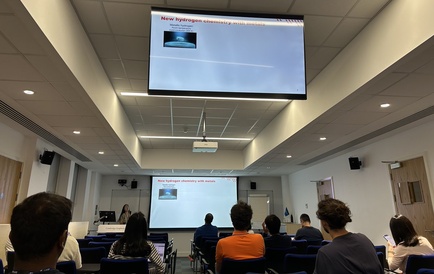
On Friday 4 July, we were delighted to welcome Dr. Maélie Caussé from the University of Cambridge to the Cambridge Graphene Centre as part of the Quantum and Advanced Materials for a Sustainable Society (QAMSS)seminar series. Her lecture, titled “A Computational Hunt for Conventional High Temperature Superconductivity,”attracted a broad audience of researchers interested in computational materials science and superconductivity.
Dr. Maélie Caussé presented recent advances in first-principles computational methods used to predict crystal structures and screen for materials with extreme properties, including high-temperature superconductors. A central focus of his talk was the use of ab initio random structure searching (AIRSS), a powerful method that has proven effective in uncovering stable and metastable materials phases.
She discussed how the development of Ephemeral Data Derived Potentials (EDDPs) has significantly accelerated the discovery process, enabling more efficient searches across a wide chemical and structural space. One exciting result from this approach is the prediction of Mg₂IrH₆ as a promising candidate for ambient-pressure, high-temperature superconductivity.
The talk concluded with a reflection on how high-throughput and data-driven techniques are changing the landscape of materials discovery. Dr. Maélie Caussé’s insights provided valuable perspective on how computational tools are increasingly central to guiding experimental work and fast-tracking technological breakthroughs in energy and quantum materials.
We are grateful to Dr. Maélie Caussé for sharing her expertise and for contributing to the dynamic discussions that followed. The QAMSS seminar series continues throughout the summer, bringing together leading voices in advanced materials science from Cambridge and beyond.