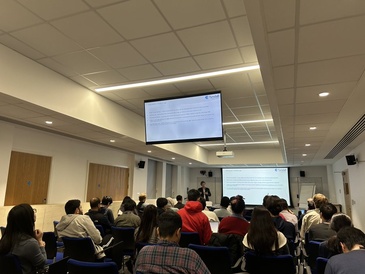
It was an honour to welcome Dr Senad Bulja from the Tyndall National Institute to the Cambridge Graphene Centre (CGC) for the final QAMSS SRI Lecture of this term.
Dr Bulja delivered an engaging talk titled “Bulk Reconfigurable Materials for Next Generation Communications”, where he explored how new materials can enable flexible and adaptive communication technologies for future 6G systems.
He explained that flexible spectrum usage depends on the ability of communications hardware, from RF to sub-THz, to adapt its operating frequency, bandwidth and radiation characteristics to support emerging 6G applications and services.
To achieve this, Dr Bulja highlighted the need for significant scientific progress in developing new reconfigurable materials that can form the basis of next-generation RF and sub-THz devices. Although reconfigurability has been explored for more than two decades, current technologies still face challenges such as high losses and limited tunability.
During his lecture, Dr Bulja presented several types of bulk, externally reconfigurable materials, including Liquid Crystals (LCs), Electro-Chromic (EC) materials, and Transition Metal Oxides (TMOs). He also shared how his group has applied these materials to develop new reconfigurable devices.
The lecture concluded with a lively discussion on the role of materials science in enabling future communication technologies. The QAMSS SRI team would like to thank Dr Bulja for his excellent talk and all participants for contributing to a successful end to this term’s lecture series.